For Codeformer Users: SiliconFlow Review 2026 — Pricing, Speed and the Catch
Looking for codeformer? Learn how SiliconFlow's API handles model access, image generation, pricing and deployment tiers before comparing inference options.
If you came looking for codeformer, this review helps you assess SiliconFlow as a broader model API, including its image-model offerings, pricing and deployment options. It does not establish whether CodeFormer itself is available on the platform.
SiliconFlow sells one OpenAI-compatible API for 200+ open and commercial models — DeepSeek, Qwen, GLM, Kimi, FLUX and more — with serverless, dedicated and fine-tuned deployment options. I went through SiliconFlow’s model catalogue, pricing tables and deployment tiers to work out where it fits for developers in 2026.
If your product calls more than one model, you have felt the pain of juggling providers: different SDKs, different billing, different rate limits. SiliconFlow’s pitch is to collapse all of that into a single endpoint — “One API for All Open and Commercial LLMs & Multimodal Models” — priced per token, per image, per video or per minute of audio, with $1 in free credits to start. I spent several days inside SiliconFlow’s catalogue, pricing pages and FAQ to understand what it actually offers, how the numbers compare, and what kind of team should route traffic through it.
I also kept a second inference platform, Synexa, open alongside SiliconFlow throughout, because the two overlap on image, video and 3D generation and diverge sharply on how GPU time is billed — more on that comparison at the end.
SiliconFlow’s positioning is speed, predictable cost and a single API across language, image, video and audio models.
What SiliconFlow is
SiliconFlow (硅基流动 in its Chinese home market) is an AI infrastructure provider. It hosts a catalogue of open-weight and commercial models behind an OpenAI-compatible API and offers three ways to run them:
- Serverless — run any model instantly, one API call, pay per use.
- Dedicated endpoints — guaranteed GPU capacity for stable performance and predictable billing.
- Fine-tuning and custom deployment — customise models to your use case with one-click deployment, or bring your own setup.
Under the hood SiliconFlow runs a self-developed inference engine on NVIDIA H100/H200, AMD MI300 and RTX 4090 hardware, and it makes a point of “no data stored, ever”. The use cases it lists — coding assistants, agentic workflows, RAG, content generation, customer-support bots, search — are the standard 2026 catalogue, which is the point: SiliconFlow wants to be the plumbing under all of them.
The SiliconFlow model catalogue
This is where SiliconFlow is genuinely strong. The catalogue is dominated by the Chinese open-weight ecosystem and it moves fast. In September 2026 alone SiliconFlow added Tencent’s Hy4-preview (roughly 770B total parameters, 49B active, native 1M context) and DeepSeek-V4.1-Flash; the weeks before brought GLM-5.3, DeepSeek-V4-Pro, Qwen3.8 and Kimi-K3. Most of these list a 1,049K total context on SiliconFlow.
Beyond chat models, SiliconFlow serves image generation (FLUX.2, Z-Image-Turbo), video generation, and audio (speech recognition, translation and CosyVoice text-to-speech). The catalogue page filters by LLM, vision, image, video and audio, and by provider.
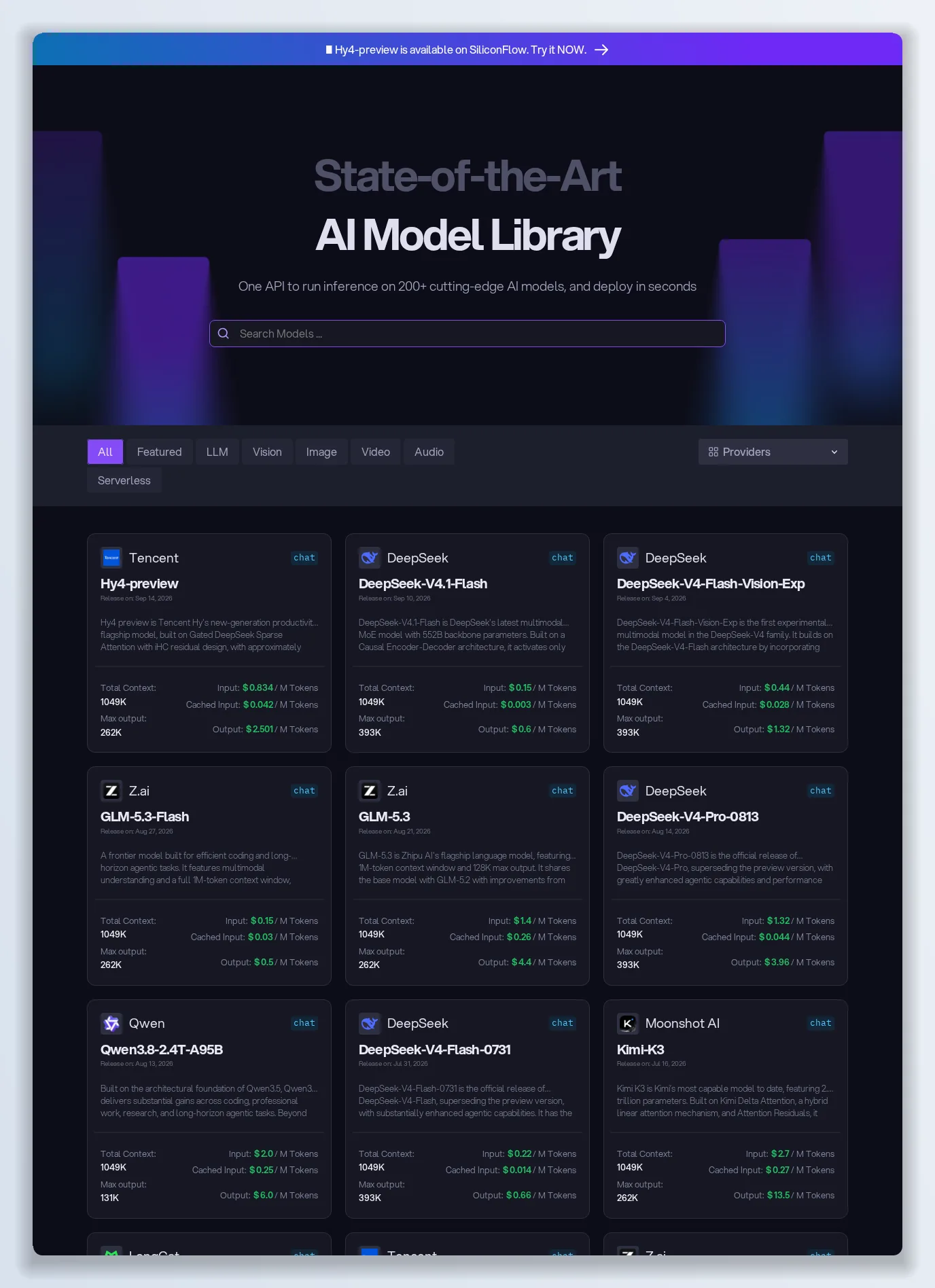
Over 200 models on one API — SiliconFlow’s catalogue is refreshed weekly and leans heavily on DeepSeek, Qwen, GLM, Kimi and Tencent releases.
SiliconFlow pricing: the actual numbers
SiliconFlow is postpaid and usage-based with no minimum commitment. You can set monthly spending limits in the dashboard, and volume discounts exist for high-usage customers via sales. Here is what the pricing page listed in September 2026 (per million tokens unless noted):
- DeepSeek-V4.1-Flash — $0.15 input / $0.60 output
- DeepSeek-V4-Flash-0731 — $0.22 / $0.66
- DeepSeek-V4-Pro-0813 — $1.32 / $3.96
- GLM-5.3-Flash — $0.15 / $0.50; GLM-5.3 — $1.40 / $4.40
- Qwen3.8–2.4T-A95B — $2.00 / $6.00
- Kimi-K3 — $2.70 / $13.50
- Tencent Hy4-preview — $0.834 / $2.501; Hy3 — $0.132 / $0.528
- LongCat-2.0 — $0.75 / $2.95
- Images: FLUX.2 [pro] $0.03, FLUX.2 [flex] $0.06, Z-Image-Turbo $0.005 per image
- Audio: transcription and translation per minute; TTS per 1,000 characters
The flash-class models are the bargain: sub-$1 per million tokens on a 1M-context model is hard to beat, and SiliconFlow lists cached-input rates lower still. The frontier-class models (Kimi-K3, Qwen3.8) are priced like frontier models anywhere.
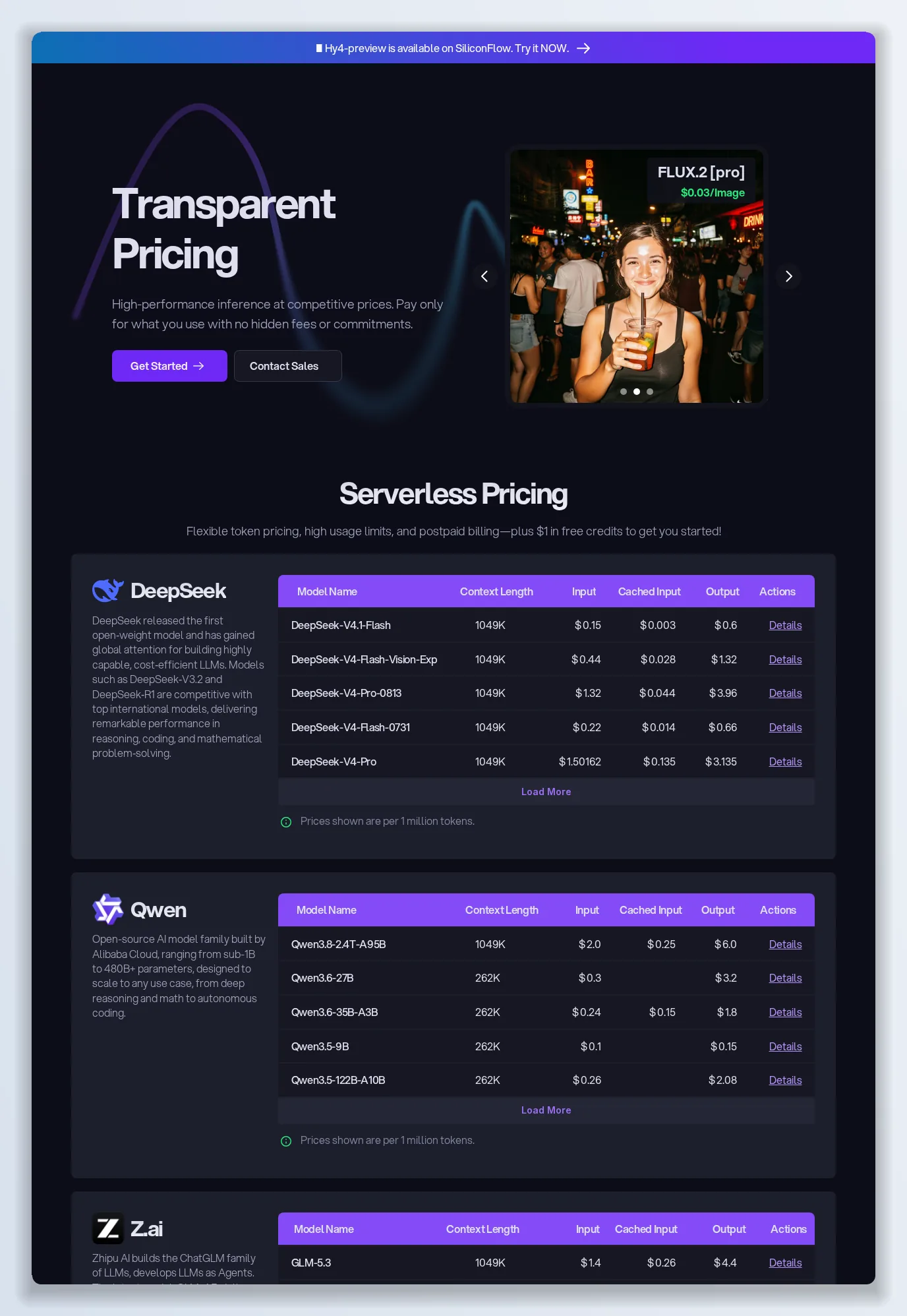
Per-token prices grouped by DeepSeek, Qwen, Z.ai, Moonshot, MiniMax and OpenAI — and $1 of free credit to start.
Getting started with SiliconFlow
The onboarding is standard for the category: sign up, take the API key, point an OpenAI-compatible client at SiliconFlow’s base URL, and the $1 of free credit covers your first experiments. Because SiliconFlow is OpenAI-compatible, migrating an existing codebase is typically a base-URL and model-name change. The documentation includes a quickstart, a playground for trying models before you write code, and a “product introduction” that describes SiliconFlow as a one-stop platform integrating top-tier LLMs.
Speed and reliability
SiliconFlow’s marketing leads with “blazing-fast inference” and “higher throughput, lower latency, and better price”, and its engine work — including native multi-token prediction for speculative decoding on Hy4-preview — is credible. The honest caveat is that serverless throughput on a shared platform fluctuates with demand; SiliconFlow’s own answer to that is the dedicated-endpoint tier with guaranteed GPU capacity, which is where predictable latency actually lives.
What SiliconFlow gets right
- Breadth and freshness. New DeepSeek, Qwen, GLM, Kimi and Tencent models land on SiliconFlow within days of release.
- Real pay-per-use. No commitments, spending caps in the dashboard, $1 free to start.
- Cheap flash-class models with 1M context.
- OpenAI compatibility that makes switching cheap.
- Three deployment modes under one account, from serverless to fine-tuned dedicated.
Where SiliconFlow falls short
- Catalogue skews to one ecosystem. If your product depends on Anthropic or Google models, SiliconFlow is not where you run them.
- The $1 free credit is a taste, not a trial. It is enough to verify the API works, not to evaluate quality across models.
- Serverless variance. Predictable latency requires a dedicated endpoint, which changes the cost model.
- Media pricing is per output, not per second. For image, video and 3D workloads, per-image billing can be pricier than per-second GPU billing once volumes grow.
- Two brands, two docs domains (siliconflow.com and siliconflow.cn) can be confusing when searching for answers.
SiliconFlow vs the alternatives
Against OpenRouter-style aggregators, SiliconFlow wins on price for open-weight models and on owning its inference stack rather than reselling. Against Western inference platforms, SiliconFlow wins on Chinese-model coverage and loses on Anthropic/Google availability. Against per-second GPU platforms, SiliconFlow is simpler for LLM workloads and less efficient for heavy media generation — which is exactly why I kept Synexa open.
Verdict: is SiliconFlow worth it in 2026?
For a developer whose stack runs on DeepSeek, Qwen, GLM or Kimi, SiliconFlow is one of the best places to run them: current models, honest per-token pricing, OpenAI-compatible, no commitment. It is a weaker fit for teams that need closed Western models or that generate images, video and 3D at scale. Get an API key and the $1 of starter credit, and try a flash-class model first.
The alternative worth keeping next to it: Synexa
Two SiliconFlow limits pushed me to keep a second platform open: media generation is billed per output rather than per GPU-second, and there is no way to run your own or a custom model on raw GPU time without the dedicated-endpoint commitment. Synexa is built around exactly those two things.
- Per-second GPU billing that scales to zero. An H100 is $0.00083 per second ($2.99/hour), an A100 80GB $2.49/hour, an RTX 4090 $0.69/hour — and when nothing is running you pay nothing.
- Cheap per-output media pricing. FLUX.1 [dev] at $0.0125 per image, FLUX.1 [schnell] at $0.0015, Stable Diffusion XL at $0.002, Wan 2.1 video at $0.20 per clip, Hunyuan 3D at $0.025 per model — Synexa’s own table shows 37–60% below the providers it compares against.
- Billing based on model output, so a failed generation is not a bill.
- Image, video and 3D under one API, the workloads where per-image pricing on SiliconFlow stops being cheap.
Route your DeepSeek and Qwen traffic through SiliconFlow. Route the image, video and 3D jobs — and anything you want on raw GPU-seconds — through Synexa.
Want to try it yourself?
Try Synexa →